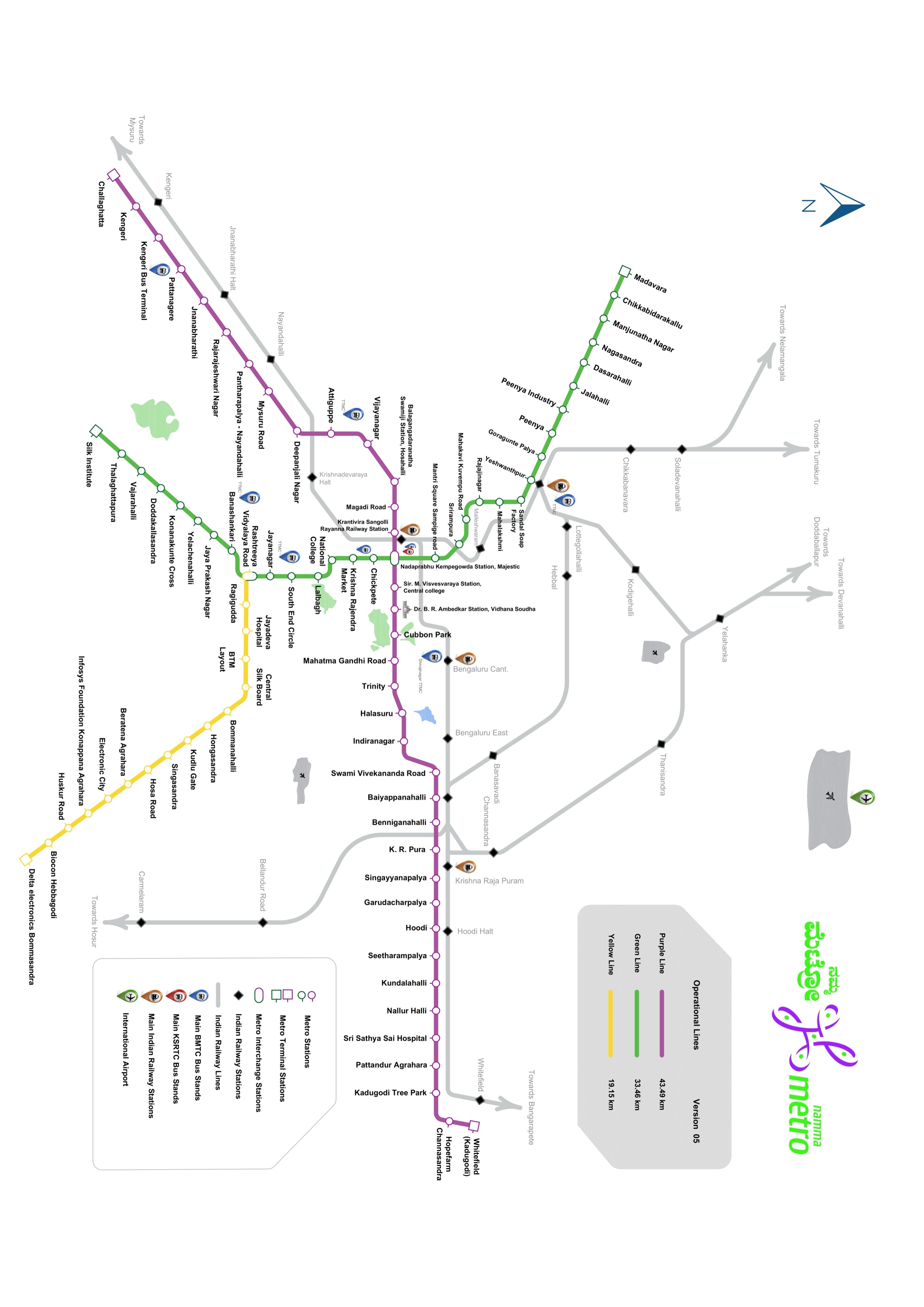
Bangalore Metro Phase 3 — Orange & Grey Line, 31 Stations & Timeline
Namma Metro Phase 3 adds 44.65 km and 31 elevated stations across two new corridors. The Orange Line (32.15 km, 22 stations) runs from JP Nagar 4th Phase to Kempapura along the western Outer Ring Road, while the Grey Line (12.50 km, 9 stations) extends from Hosahalli to Kadabagere along Magadi Road. The project features India's first integrated double-decker metro corridor and was approved by the Union Cabinet in August 2024 at ₹15,611 crore. PM Modi laid the foundation stone on August 10, 2025. Updated August 2026.
Union Cabinet approved Phase 3 on August 16, 2024. PM Modi laid the foundation stone on August 10, 2025. Civil work tenders for the first 18.5 km were floated in January 2026. JICA signed a ₹6,100 crore loan in March 2026. Ground construction began June 2026, targeting completion by May 2031.
Phase 3 — Quick Facts
- Corridors: Orange Line (32.15 km, western ORR) + Grey Line (12.50 km, Magadi Road)
- Stations: 31 (all elevated) • Total length: 44.65 km
- Cost: ₹15,611 crore (+ ₹9,700 crore for double-decker road flyover)
- Status: Cabinet approved Aug 2024 — foundation stone laid Aug 2025
- Construction start: June 2026
- Target completion: May 2031
- Double-decker viaduct: ~37 km (metro rail above road flyover)
- Funding: JICA ODA loan of ₹6,100 crore signed March 2026
- Daily ridership (projected): 7.85 lakh passengers
Phase 3 at a Glance
| Total length | 44.65 km (32.15 km Orange + 12.50 km Grey) |
| Number of stations | 31 (22 Orange + 9 Grey, all elevated) |
| Cabinet-approved cost | ₹15,611 crore |
| RITES EIRR | 15.9% (above 14% Centre benchmark) |
| Union Cabinet approval | August 16, 2024 |
| Foundation stone | August 10, 2025 (PM Modi) |
| Construction start | June 2026 |
| Target completion | May 2031 |
| Double-decker viaduct | ~37 km (metro + road flyover on same structure) |
| Projected daily ridership | 7.85 lakh passengers |
| Post-completion network | ~220 km total metro coverage |
| Operator | BMRCL (Namma Metro) |
Orange Line — 22 Stations (JP Nagar 4th Phase to Kempapura)
The Orange Line runs 32.15 km along the western Outer Ring Road from JP Nagar 4th Phase in the south to Kempapura near Hebbal in the north. This corridor passes through Hosakerehalli, Mysuru Road, Nagarbhavi, Peenya and Hebbal — bringing metro connectivity to the western half of the ORR for the first time. Includes a 28.5 km double-decker viaduct section.
| # | Station | Notes |
|---|---|---|
| 1 | JP Nagar 4th Phase | Southern terminus. Interchange — Pink Line. |
| 2 | JP Nagar 5th Phase | JP Nagar residential area. |
| 3 | JP Nagar | Interchange — Green Line. |
| 4 | Kadirenahalli | Kadirenahalli, south-west Bengaluru. |
| 5 | Kamakya Junction | Near Banashankari 6th Stage. |
| 6 | Hosakerehalli | Hosakerehalli area. |
| 7 | Dwaraka Nagar | Western Bengaluru. |
| 8 | Mysuru Road | Interchange — Purple Line. |
| 9 | Nagarbhavi Circle | Nagarbhavi, western Bengaluru. |
| 10 | Vinayaka Layout | Near Nagarbhavi. |
| 11 | Papireddy Palya | Near BDA layout. |
| 12 | BDA Complex Nagarbhavi | BDA complex area. |
| 13 | Sumanahalli Cross | Interchange — Grey Line (Phase 3). |
| 14 | Chowdeshwari Nagar | North-west Bengaluru. |
| 15 | Freedom Fighter's Colony | Near Rajajinagar. |
| 16 | Kanteerava Nagar | Near Yeshwanthpur. |
| 17 | Peenya | Interchange — Green Line. Peenya Industrial Area. |
| 18 | Muthyala Nagar | Near Yeshwanthpur. |
| 19 | BEL Circle | Near BEL factory, Jalahalli. |
| 20 | Nagashetty Halli | North Bengaluru. |
| 21 | Hebbal Railway Station | Interchange — Blue Line & Red Line. |
| 22 | Kempapura | Northern terminus. Interchange — Blue Line. |
Grey Line — 9 Stations (Hosahalli to Kadabagere)
The Grey Line runs 12.50 km westward from Hosahalli along Magadi Road to Kadabagere, bringing metro connectivity to the western suburbs for the first time. Includes an 8.6 km double-decker viaduct section. Passengers from the Grey Line can transfer to the Purple Line at Hosahalli for Majestic, MG Road and the rest of the network.
| # | Station | Notes |
|---|---|---|
| 1 | Hosahalli | Eastern terminus. Interchange — Purple Line. |
| 2 | KHB Colony | Karnataka Housing Board Colony. |
| 3 | Kamakshipalya | Kamakshipalya, Magadi Road. |
| 4 | Sumanahalli Cross | Interchange — Orange Line (Phase 3). |
| 5 | Sunkadakatte | Near metro depot. |
| 6 | Herohalli | Herohalli, western suburbs. |
| 7 | Byadarahalli | Byadarahalli area. |
| 8 | Forest Gate | Near Bannerghatta Forest area. |
| 9 | Kadabagere | Western terminus. End of Magadi Road corridor. |
The Double-Decker Viaduct
The defining feature of Phase 3 is the double-decker viaduct — an elevated structure where the metro rail runs on the upper deck and a road flyover runs below it. This is India's first integrated double-decker metro corridor.
- Orange Line: 28.5 km double-decker section from Delmia Circle to Hebbal — Bengaluru's longest flyover.
- Grey Line: 8.6 km double-decker section from KHB Colony to Kadabagere.
- Total double-decker: ~37 km of combined metro-and-road infrastructure.
- Why double-decker? — Avoids acquiring additional land in densely built-up corridors. By stacking road and rail on the same alignment, the project reduces land acquisition costs and minimises displacement.
- Additional cost: — Karnataka approved ₹9,700 crore for the road flyover component beneath the metro viaduct.
Phase 3 Timeline
✓ DPR & Cabinet Approval — August 2024
RITES completed its assessment (15.9% EIRR). The Union Cabinet approved Phase 3 on August 16, 2024, at ₹15,611 crore.
✓ Foundation Stone — August 10, 2025
PM Narendra Modi laid the foundation stone for Phase 3 at a ceremony in Bengaluru. At the same event, he inaugurated the Yellow Line (RV Road to Bommasandra, 19 km, 16 stations).
✓ JICA Loan Agreement — March 2026
Japan International Cooperation Agency (JICA) signed a ₹6,100 crore ODA loan agreement for Phase 3 (Tranche I). 30-year repayment period with a 10-year grace period.
✓ Civil Tenders Floated — January 2026
BMRCL floated civil work tenders for the first 18.5 km of the Orange Line in three packages worth ~₹4,229 crore. Grey Line tenders expected to follow.
✓ Construction Started — June 2026
Ground construction began in June 2026. Land acquisition is underway — BMRCL has acquired 26,811 sq m in the first phase.
🎯 Target Completion — May 2031
Full 44.65 km corridor targeting completion by May 2031. Upon completion, Bengaluru's total metro network will reach ~220 km.
Interchanges & Connections
Phase 3 integrates deeply with the existing and upcoming metro network through multiple interchange stations:
| Station | Connects with |
|---|---|
| JP Nagar 4th Phase | Pink Line |
| JP Nagar | Green Line |
| Mysuru Road | Purple Line |
| Sumanahalli Cross | Grey Line ↔ Orange Line |
| Peenya | Green Line |
| Hebbal Railway Station | Blue Line + Red Line |
| Kempapura | Blue Line |
| Hosahalli | Purple Line |
What Phase 3 Means for Bengaluru
- Western ORR connected — JP Nagar, Nagarbhavi, and the western arc of the Outer Ring Road currently have no metro service. The Orange Line fills this gap, connecting south-west Bengaluru through Peenya to Hebbal.
- Western suburbs on the map — The Grey Line extends metro service along Magadi Road to Kadabagere, connecting the fast-growing western suburbs to the network for the first time.
- Past 220 km — With all phases combined, the metro network crosses 220 km — a scale at which the system becomes a genuine alternative to road travel across the city.
- Eight interchange points — Phase 3 creates transfer connections with the Purple, Green, Pink and Blue Lines, plus the upcoming Red Line — making the network truly interconnected.
- Road + rail on the same structure — The double-decker viaduct simultaneously improves both road and rail capacity, a first for an Indian metro.
Phase 3 — Frequently Asked Questions
What is Bangalore Metro Phase 3?
Namma Metro Phase 3 adds 44.65 km and 31 elevated stations across two corridors: the Orange Line (32.15 km, 22 stations from JP Nagar 4th Phase to Kempapura along the western ORR) and the Grey Line (12.50 km, 9 stations from Hosahalli to Kadabagere along Magadi Road). The project was approved by the Union Cabinet in August 2024 at ₹15,611 crore and features a double-decker viaduct design.
When will Phase 3 be completed?
Phase 3 is targeting completion by May 2031. PM Modi laid the foundation stone on August 10, 2025. Civil work tenders for the first 18.5 km were floated in January 2026, and ground construction began June 2026. JICA signed a ₹6,100 crore loan in March 2026.
What is the double-decker viaduct?
The double-decker viaduct is a structure where the metro rail runs on the upper deck and a road flyover runs on the lower deck. It spans approximately 37 km across both corridors (28.5 km on the Orange Line, 8.6 km on the Grey Line). This is India's first integrated double-decker metro corridor.
What are the stations on the Orange Line?
The 22 stations from south to north: JP Nagar 4th Phase, JP Nagar 5th Phase, JP Nagar, Kadirenahalli, Kamakya Junction, Hosakerehalli, Dwaraka Nagar, Mysuru Road, Nagarbhavi Circle, Vinayaka Layout, Papireddy Palya, BDA Complex Nagarbhavi, Sumanahalli Cross, Chowdeshwari Nagar, Freedom Fighter's Colony, Kanteerava Nagar, Peenya, Muthyala Nagar, BEL Circle, Nagashetty Halli, Hebbal Railway Station, and Kempapura.
How much does Phase 3 cost?
The Union Cabinet approved Phase 3 at ₹15,611 crore. Karnataka separately approved ₹9,700 crore for the double-decker road flyover. Funding comes from Centre + State equity, subordinate debt, and a ₹6,100 crore JICA ODA loan signed in March 2026.
Which existing lines will Phase 3 connect with?
Phase 3 interchanges with the Purple Line at Mysuru Road and Hosahalli; the Green Line at Peenya and JP Nagar; the Pink Line at JP Nagar 4th Phase; and the Blue Line at Hebbal and Kempapura. Sumanahalli Cross is the interchange between the Orange and Grey Lines.
Phase 3 on the Metro Map
See where the Phase 3 corridors fit in the full Namma Metro network.